Finding Gluten-Free Pizza in Philadelphia Without Guessing at the Crust
A gluten-free pizza can look exactly like every other pie on the table, which is why the difference is easy to miss. For a diner with celiac disease, the gap between a safe slice and a reaction can come down to a shared flour bag, a peel dusted with regular flour, or a pizza stone that was never cleaned between orders.
Diners searching for gluten free pizza philadelphia are usually trying to answer a narrow question: which kitchens can produce a pie that is safe for someone who cannot tolerate gluten, and how do you confirm it before the food arrives? The city has a deep pizza tradition, but gluten-free handling varies widely from one counter to the next, and a menu line alone rarely tells the full story.
The practical starting point is understanding what a restaurant is actually promising. Ingredient choices, preparation methods, and staff training are separate questions, and a pizzeria can be strong on one while leaving gaps on another. Before ordering at The Tomato Shack salad & pizza co, Manayunk or any other pizza counter, it helps to know which questions to ask and what a credible answer sounds like.
What "Gluten-Free" Actually Means on a Pizza Menu
Gluten is a protein found in wheat, barley, and rye. Under the U.S. Food and Drug Administration’s labeling rule (21 CFR 101.91), a packaged food labeled "gluten-free" must contain fewer than 20 parts per million of gluten. That standard governs packaged products, not restaurant menus. When a restaurant calls a pie gluten-free, it is making a claim that may or may not be backed by a certification or a documented process.
Ingredient Sourcing vs. Preparation Safety
Two separate questions determine whether a pizza is appropriate for someone with celiac disease:
- Ingredient sourcing: Is the dough made from rice, tapioca, sorghum, or a certified gluten-free flour blend rather than wheat flour? Many kitchens use frozen, pre-made gluten-free crusts, which vary in quality and cost.
- Preparation safety: Do the crust, toppings, and equipment stay separate from wheat flour during dough handling, stretching, baking, and cutting?
A crust made with gluten-free flour can still be unsafe if it is stretched on a bench that also handled regular dough, slid onto a peel dusted with wheat semolina, or baked on a stone where a regular pie dropped crumbs. Flour dust is airborne, and shared cutters or fryer oil create the same risk. Asking only "is the crust gluten-free?" misses the handling question entirely.
Common hidden sources of gluten to ask about include:
- Sauces and gravies thickened with wheat flour, and some pre-made pesto or dressings
- Sausage and meatballs bound with breadcrumbs
- Processed meats with wheat-based fillers or seasonings
- Seasoned croutons, breadsticks, and crispy fried onions on salads
- Malt vinegar and some marinated vegetables
- Beer-battered or breaded appetizers fried in shared oil
Third-party certification provides stronger assurance than a verbal promise. The Gluten-Free Certification Organization (GFCO) audits ingredients and facility practices against a 10 ppm standard, which is stricter than the FDA threshold. For a restaurant, staff training such as ServSafe Allergens, an ANSI-accredited course, indicates that someone on the team has formal allergen instruction. Philadelphia restaurants also operate under the Philadelphia Food Code, enforced by the Department of Public Health, but routine inspections do not verify gluten-free handling specifically.
How Restaurants Typically Structure Their Gluten-Free Offer
Gluten-free options generally appear in one of three formats:
- A dedicated gluten-free menu: Items are pre-built with a defined process. This signals planning, though it still requires questions about shared prep.
- A short list of adaptable dishes: A few items can be modified. This shows flexibility, but the workflow is often improvised during service.
- An "ask us" policy: No printed options exist, so the answer depends entirely on the server. Ask to speak with the kitchen or the chef when this happens.
A separate menu does not automatically mean a separate workspace. Giorgio on Pine, a BYO Roman trattoria in Center City, states that it offers a separate gluten-free menu and that any appetizer or entrée can be made gluten-free on request. That two-track approach is useful as a model: the printed menu shows what the kitchen has planned, while the request option shows what is flexible. In either case, ask whether the gluten-free item is prepared on separate surfaces, with clean tools, and whether it is cooked before wheat-based orders.
Pricing offers another clue. Gluten-free crust surcharges at area pizzerias commonly run from about $2 to $5 per pie, and frozen certified crusts retail for roughly $6 to $9 each. A modest upcharge is consistent with a real gluten-free process; a suspiciously low price may mean shortcuts.
Choosing a Spot Based on Your Group, Location, and Dining Style
Location shapes both travel time and the kind of service you can expect. Center City has the highest density of restaurants and is served by SEPTA’s Market-Frankford Line and regional rail, which makes it easy to compare several kitchens in one trip. Manayunk, along Main Street, has a more neighborhood feel, with steep grades, narrow streets, and limited parking; the Manayunk/Norristown Line regional rail stop is the simplest transit option for many diners.
Dining format also changes how special orders are handled:
- Sit-down trattoria: Staff have more time to coordinate with the kitchen, but busy weekend dinners can slow requests.
- Casual counter: Service is fast, but a small crew may not have separate stations for gluten-free orders.
- Takeout-first shop: Boxes are packed quickly, so ask for separate bagging, labeled containers, and a note on the ticket.
BYO restaurants and private-event venues work differently. Their menus are often set in advance, and modifications require more lead time. Giorgio on Pine, for example, asks groups of 25 or more to call for lunch availability, and private events are typically arranged well ahead of the date. Confirm gluten-free accommodations when you book, not on arrival.
Ordering Smoothly for Mixed-Diet Tables
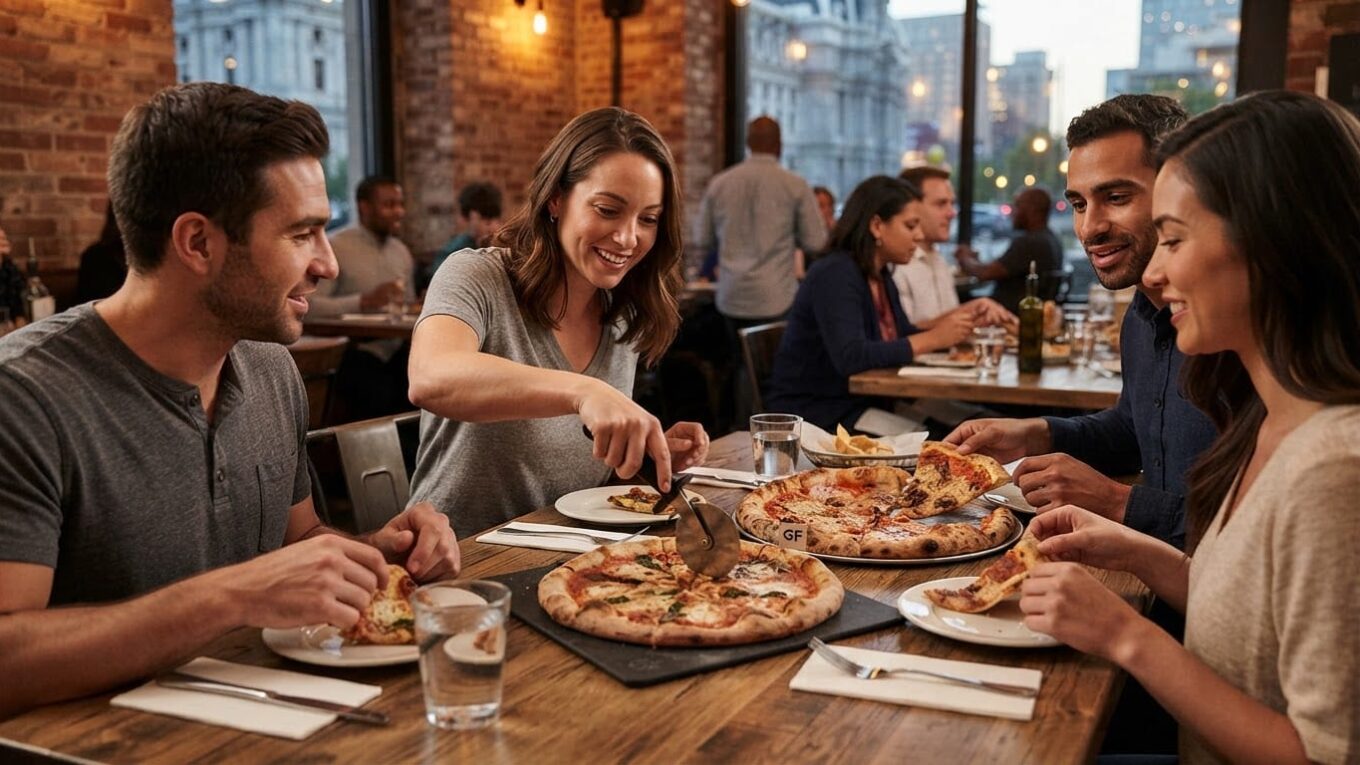
When some diners need gluten-free food and others do not, the safest approach is to keep the orders physically separate. A gluten-containing pie should never be shared with a celiac diner, even if the gluten-free diner takes only "a few slices" of the other pie. Cut toppings can transfer crumbs, and cheese and sauce can carry gluten across a shared pizza.
Practical steps for a mixed table:
- Order the gluten-free pie as its own item, not as a substitution on a shared order.
- Ask whether the pie will be made first, on a clean screen or pan, before the wheat-based pies enter the oven.
- Request a separate cutter or ask the kitchen to cut the gluten-free pie before the others are sliced.
- For larger groups, ask whether the gluten-free dough is made in a dedicated area.
Timing matters. For parties of six or more, call ahead 24 to 48 hours in advance so the kitchen can plan its prep. During peak dinner hours, ask when the gluten-free pie will come out and whether it can be sent first. A simple question at the start of service gives the kitchen time to schedule it rather than fitting it in mid-rush.
Communicating an allergy requires more than telling the host. Tell the server directly, specify whether the diner has celiac disease or a sensitivity, and ask that it be written on the ticket. Celiac disease is a medical condition requiring strict avoidance, and kitchen staff respond differently when they understand that distinction. If the server seems unsure, ask whether the kitchen has been informed, and check again when the food arrives. The final confirmation should come from the people cooking the food, not just from the table.
