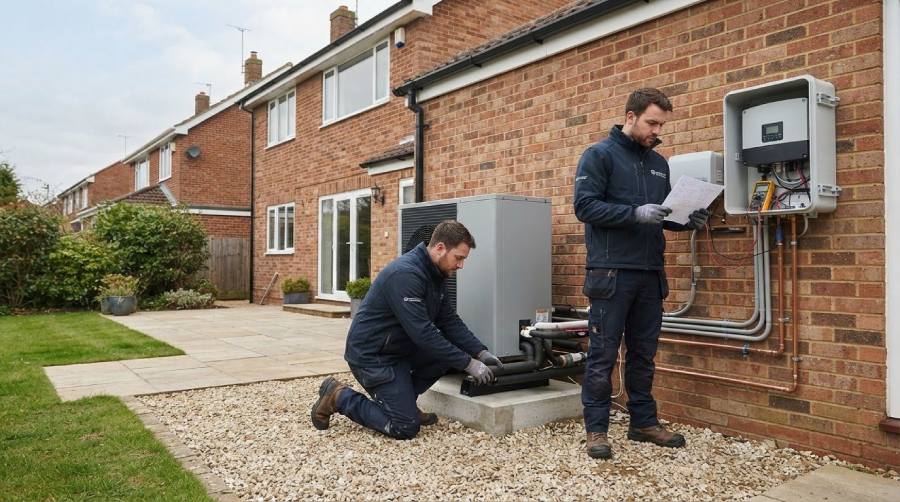
Heat Pump Installation in the UK: Choosing the Right System
A heat pump can reduce reliance on fossil-fuel heating, but its success depends more on design quality than on the headline efficiency printed in a brochure. The right system must match the building’s heat loss, emitters, hot-water demand and available space.
For homeowners researching amheatpumps, the most useful starting point is an independent understanding of how air source and ground source technology works, what a professional installation includes and which questions should be answered before accepting a quotation.
Unlike a boiler, a heat pump does not primarily create heat by burning fuel. It uses electricity to move low-temperature heat from outside into the home. A refrigeration cycle raises that heat to a usable temperature for radiators, underfloor heating and domestic hot water.
Is a Heat Pump Suitable for Your Property?
Heat pumps can work in many UK homes, including older properties, but the building and heating system may need improvement first. A room-by-room heat-loss calculation should identify how much heat each space requires on a cold design day.
Important considerations include:
- Insulation and draughts: Loft, wall, floor and glazing performance affect the required heat-pump output. Better insulation can reduce equipment size and running costs.
- Radiators: Heat pumps commonly operate at lower flow temperatures than gas boilers. Existing radiators may need to be replaced with larger models or low-temperature emitters.
- Underfloor heating: Large floor areas suit low-temperature heating particularly well, although retrofit work can be disruptive.
- Outdoor space: Air source systems need a correctly positioned outdoor unit with suitable airflow, drainage and clearance.
- Hot-water demand: A heat-pump cylinder normally stores hot water. Household size, bathing habits and available cylinder space influence the required capacity.
A property does not have to be perfectly airtight, but excessive heat loss can make a system expensive to run. Homes that feel cold after installation often have an incorrectly calculated heat loss, undersized radiators, poor hydraulic balancing, unsuitable control settings or incomplete commissioning. Frequent boiler-style “on and off” operation can also undermine comfort; heat pumps generally work best when operating steadily for longer periods.
Air Source vs Ground Source Heat Pumps
Air source systems
An air source heat pump extracts heat from outdoor air through a fan-assisted heat exchanger. In an air-to-water system, the heat is transferred into a water circuit that supplies radiators, underfloor heating and a hot-water cylinder.
The outdoor unit is usually installed against, or near, an external wall. Its position must account for noise, airflow, maintenance access, condensate drainage and the effect of defrost cycles. Planning requirements vary by property and location, particularly for listed buildings, conservation areas or installations close to boundaries.
Air source systems usually involve less disruption and lower installation costs than ground source systems. They are often practical for semidetached and urban homes, provided there is enough space for the unit and associated pipework. Their efficiency varies with outdoor temperature: performance generally falls during colder weather, when the heating demand is greatest.
Ground source systems
A ground source heat pump collects heat through buried horizontal ground loops or vertical boreholes. The collector contains a water-and-antifreeze mixture, which circulates underground before transferring heat to the heat pump inside the property.
Ground temperatures are relatively stable compared with outdoor air, allowing consistent performance. However, horizontal loops require substantial garden area and excavation. Boreholes reduce the surface footprint but require specialist drilling access, geological assessment and additional groundwork.
Ground source may justify its higher capital cost where:
- The property has suitable land or drilling access.
- The heating demand is substantial and long-term occupancy is expected.
- Consistent efficiency and reduced exposure to winter air temperatures are priorities.
- Major landscaping or construction work is already planned.
There is no universally superior technology. A survey should compare collector feasibility, heat loss, expected flow temperatures, electricity supply, access and the total lifecycle cost.
What a Proper Heat Pump Design and Installation Includes
A credible process begins with a measured survey rather than a product recommendation. The designer should calculate heat loss for every room using dimensions, construction, ventilation and desired indoor temperatures. A whole-house estimate alone may conceal cold rooms or oversized equipment.
Survey findings determine:
- Heat-pump output and operating range.
- Radiator or underfloor-heating capacity.
- Design flow and return temperatures.
- Cylinder size and recovery strategy.
- Buffer tank requirements, if any.
- Weather compensation and room-control arrangements.
The installer should also assess electrical capacity, consumer-unit requirements, pipe diameters, insulation, condensate drainage and the location of internal components. An outdoor unit needs stable foundations, adequate clearances and a position that limits transmitted noise and nuisance to neighbours.
For ground source installations, the design must cover loop length, borehole depth, ground conditions, antifreeze concentration, trench restoration and collector protection. For either technology, pipework should be properly insulated and commissioned for correct flow rates.
Installation is only one stage of the work:
- Design: Heat loss, emitter sizing, hydraulic layout and controls are specified.
- Installation: Equipment, pipework, cylinder, electrical connections and external works are fitted.
- Commissioning: The system is pressure-tested, flushed, balanced and configured. Flow temperatures, weather-compensation curves, pump speeds and safety settings are checked.
- Handover: The homeowner receives manuals, warranty information, commissioning records and clear instructions for heating, hot water and controls.
A technically sound system can still disappoint if the weather-compensation curve is wrong, thermostatic radiator valves restrict flow unnecessarily or the cylinder schedule does not match household routines. Homeowners should receive practical guidance rather than being left with factory default settings.
Heat Pump Costs, Running Performance and Available Support
Indicative UK costs vary sharply by building complexity:
- An air-to-water installation for a typical two- or three-bedroom home may fall around £11,000–£18,000 before applicable grants or unusual remedial work.
- A larger or technically complex air source project can exceed £20,000, particularly where radiators, electrical infrastructure or pipework require upgrades.
- Ground source systems commonly cost approximately £20,000–£40,000 or more, depending on boreholes, trenching, access, land restoration and collector design.
The quotation may include the survey, design, heat-pump unit, cylinder, controls, labour, scaffolding, electrical work and commissioning. It may exclude insulation, radiator replacement, planning fees, asbestos precautions, landscaping or consumer-unit upgrades. These exclusions should be explicit.
Running performance is commonly discussed using the coefficient of performance (COP), but real-world seasonal efficiency is better represented by the seasonal coefficient of performance (SCOP). Results depend on:
- Building heat loss and indoor temperature.
- Flow temperature and emitter sizing.
- Defrosting requirements for air source units.
- Weather-compensation controls and hydraulic balancing.
- Electricity tariff, smart-meter options and maintenance.
- Domestic hot-water temperature and immersion-heater use.
A payback calculation should compare actual fuel use, electricity prices, maintenance and capital cost. It should not assume a guaranteed saving. A heat pump may offer lower carbon emissions and improved comfort even where financial payback is lengthy, but the numbers should be specific to the property.
Government support changes over time. In England and Wales, schemes such as the Boiler Upgrade Scheme have included grants for eligible air source and ground source installations, subject to current rules, installer certification and property conditions. Scotland and Northern Ireland have separate arrangements. Check official government guidance before relying on a grant, and confirm that the installer is appropriately certified—MCS registration is particularly important for eligibility under applicable schemes.
Choosing an Installer and Planning the Next Step
Obtain a property-specific survey before deciding between air source and ground source technology. Compare quotations using the following checklist:
- Is there a room-by-room heat-loss calculation?
- What indoor and outdoor design temperatures have been used?
- What flow temperature is expected on the coldest design day?
- Which radiators or underfloor circuits will be retained or upgraded?
- What are the proposed SCOP, sound-power level and operating limits?
- Is the cylinder correctly sized for the household?
- Are electrical work, groundwork, drainage and making-good included?
- Does the quote include commissioning records and user training?
- What product, workmanship and parts warranties apply?
- Who handles faults after installation, and within what response time?
Ask to see evidence of comparable installations, particularly homes with similar construction and heating requirements. Questions about noise planning should cover the manufacturer’s sound data, boundary distances, night operation and anti-vibration measures.
Homeowners should also clarify whether the system can provide adequate hot water during consecutive showers, how quickly rooms recover after setback, whether smart controls are compatible and which components require periodic servicing. Ground source owners should ask about loop protection and antifreeze checks; air source owners should ask about defrost behaviour and condensate management.
The most reliable installation is not necessarily the largest, cheapest or most heavily promoted. It is the system supported by transparent calculations, suitable emitters, careful commissioning and realistic advice about how a low-temperature heating system should be operated.
