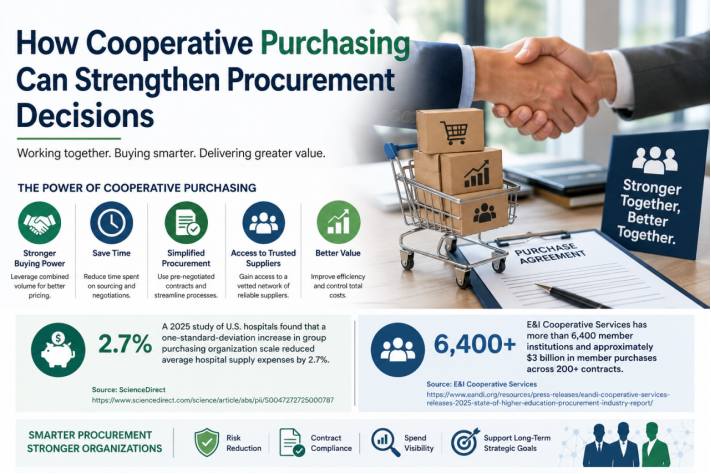
How Cooperative Purchasing Can Improve Procurement Decisions
Procurement teams have the challenge of balancing the need for efficiency with the need to control costs and procurement against the quality and needs of the organization. Assessing and negotiating the terms of contracts with suppliers can take a lot of time. A cooperative purchasing model is an alternate way to tackle this dilemma.
Buying cooperatives bring organizations together to buy goods and services using combined demand. Rather than negotiating each purchase independently, member organizations gain the benefit of contracts and pricing that have been negotiated by the group as a whole. This model is attractive for organizations that desire more purchasing power, but don’t wish to build a large procurement division.
Transforming Collective Demand Into Purchasing Power
The concept of cooperative purchasing is straightforward. Combining demand draws suppliers to serve a larger market, and in turn, strengthens the position of an individual organization in negotiating competitive contract terms.
Some of the repetitive work involved in procurement could also be eliminated, since members of a cooperative purchasing organization can use the contracts that have already been negotiated, rather than having to source every member’s purchase individually.
The following benefits are associated with procurement teams:
Access to less expensive contracts resulting from a competitive sourcing process
- Streamlined supplier negotiation processes
- A greater ability to buy when needed
- An easier procurement process
- More procurement options
The Financial Impact of Group Purchasing
The 2025 Journal of Public Economics study titled “The Value of Group Purchasing: Evidence from the U.S. Hospital Industry” found that a one-standard-deviation increase in GPO scale reduced an average hospital’s supply expenses by 2.7%. The researchers estimated this would be a savings of approximately $48 per hospital discharge and would result in an estimated savings of $720,000 for the average hospital.
These reductions and savings demonstrate the importance of purchasing group scale. Yet contracts must provide savings and address the operational needs of the organization for the length of the procurement agreement, while ensuring that suppliers perform reliably.
Why Procurement Teams Need More Than Lower Prices
Simply put, lower prices may not yield better value. Other factors include product quality, service levels, contract terms, supplier reliability, and the ability to comply with organizational requirements.
Value may be achieved most effectively through cooperative purchasing. A coop purchasing organization can consolidate many of the activities of the procurement process, including supplier research, competitive procurement, contract administration, and member requirements. This allows procurement staff to focus on the organizational value and importance of strategic sourcing decisions.
Building a More Effective Procurement Model
Using a procurement cooperative model can help standardize an organization’s purchasing activities. Instead of allowing separate teams to negotiate purchasing agreements for the same goods or services, a shared purchasing agreement can establish a common contract for the organization. This can help procurement teams identify and align the organization’s purchasing objectives.
An Illinois higher education report found that state universities spent about $890 million through 20 cooperative purchasing organizations in FY 2024, showing the widespread use of this approach.
Conclusion
Cooperative purchasing should be part of a complete procurement process for organizations. Optimizing procurement contracts and supplier partnerships can bring about a reduction in repetitive procurement work and increase marketplace dominance for procurement teams. This allows teams to address the organization’s procurement needs with a greater degree of strategic focus and longer-term perspective.
